

How AI Has Changed the Digital Transformation Model
For decades, technology transformation followed a familiar sequence: assess the current state, recommend a future state, build a roadmap, and then build. Each stage had a clear owner, a clear deliverable, and a clear handoff to the next. The model was linear because the underlying technology was largely linear; you specified a system, built it, shipped it, and it worked roughly the way it worked on day one for years afterward.
That model is breaking down. Not because assessment, recommendation, and planning have stopped mattering, but because the systems being built no longer behave like traditional software. And that changes the shape of delivery itself.
From sequential stages to embedded cycles
The old model moved in a straight line: assess, recommend, roadmap, build. Each phase closed before the next opened. Consultants handed a business case to architects, architects handed a design to engineers, and engineers built to spec.
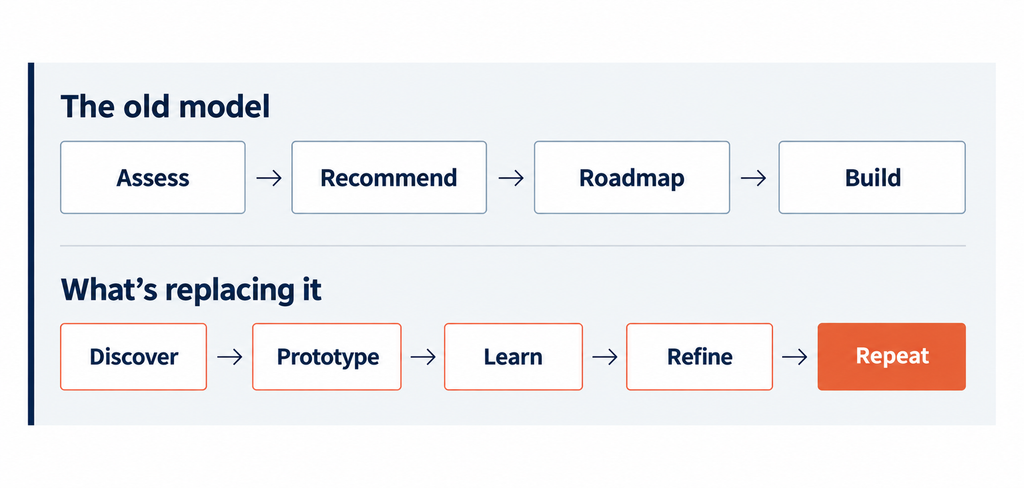
What’s replacing it isn’t a faster version of the same line, it’s a different shape entirely. Delivery is becoming embedded and iterative: discover, prototype, learn, refine, repeat. There is no clean handoff between “figuring out what to build” and “building it,” because the two increasingly happen in the same room, in the same sprint, sometimes in the same conversation. Discovery does not finish before prototyping starts; it continues because the prototype itself becomes a discovery tool. You learn what the business actually needs by putting something in front of it, not by writing a longer document about it first.
AI is the reason the cycle does not close
This shift isn’t a process fad. It’s a direct consequence of what AI actually is as a technology. A traditional system, once built and tested, is largely done and the code that shipped is the code that runs. An AI system is different by nature. It keeps evolving after go-live: models get retrained, prompts get refined, edge cases surface in production that no discovery phase could have anticipated, and the system’s behavior shifts as the data around it shifts.
That means implementation isn’t a one-time event with a defined end date. It’s an ongoing capability that requires continuous tuning, closer to running a living system than closing out a project. A team that treats an AI rollout as a project with a go-live date and a wrap-up deck has misunderstood what they built. The go-live is closer to the midpoint than the finish line.
The delivery cycle is collapsing
The consequence is not simply that teams can work faster. It is that the traditional planning horizon itself is becoming less relevant. Prototyping cycles that once took months can now happen in weeks, while experimentation, testing, and iteration happen in a continuous loop. A working prototype can be tested against real users or real data and materially redesigned within days.
That changes the logic of the traditional assess–recommend–roadmap–build model. When capabilities can be tested and reshaped in weeks, a six-month planning horizon can become obsolete before implementation even begins. The implication is therefore bigger than speed. The objective shifts from planning what to build to continuously learning what works and building toward it.
The big players are re-architecting around this
This isn’t a theoretical shift; it’s visible in how the largest consulting and cloud players are restructuring themselves. Instead of handing recommendations from the outside and returning months later with a build, teams are moving engineers and consultants directly into client environments to build live, alongside the client’s own teams. The centre of gravity is moving from the advisory deck to the shared workspace. When market leaders begin re-architecting delivery around embedded, live building, it is a strong signal that the old model is not simply ageing; it is being actively displaced.
But this creates a new problem: building faster does not necessarily mean solving the right problem.
The missing ingredient is judgment
AI makes it easier than ever to build the wrong thing quickly, and to make it look convincing. A technically elegant solution can still solve a problem nobody needed solved. Move fast without judgment, and you get a well-engineered answer to the wrong question.
What’s missing from a purely engineering-led model is business judgment: knowing which problem is worth solving before building anything at all. That judgment comes from understanding the business, its constraints, its incentives, where value is actually being lost, and which interventions will move the metrics that matter.
The answer, then, is not to choose between business expertise and technical capability. It is to bring them together.
The winning model pairs the “why” with the “how”
The model that emerges is neither purely business-led nor purely engineering-led. It combines deep business and domain understanding with hands-on build capability in the same team, rather than separating the two and reconnecting them at a handoff point. Embedded teams that carry both the “why” and the “how” are structurally different from teams where one group thinks and another builds. When the same team holds both, the prototype can be refined against the real business question in real time, rather than against a specification that was frozen weeks earlier.
This is what AI-driven delivery demands: continuous iteration, grounded in business context, with judgment guiding every cycle of discovery, experimentation, and refinement.
But there is a broader implication. When AI is not simply a technology being implemented, but an active participant in how work gets done, the consulting question changes. It is no longer enough to redesign technology or automate individual activities. Consultants have to understand how work itself changes when humans and AI agents operate together.
From AI-enabled technology to Human + AI operating models
Unlike technologies such as automation or traditional data science, which largely replaced human activities or enhanced existing operations, AI — particularly through Human-in-the-Loop (HIL) models — is changing the way work is performed and, consequently, the way consulting itself needs to be done.
The consulting frameworks are therefore not simply being amended. They are being redesigned around a fundamentally different operating model: one in which humans and AI jointly execute, learn, and make decisions.
Consider process discovery in a function such as Procure-to-Pay. Traditionally, a discovery study would involve measuring throughput, cycle times, and inefficiencies through time-and-motion studies, data analysis, and stakeholder interviews. With AI agents actively operating within these processes, much of this intelligence can be captured continuously and at scale. Discovery is therefore no longer primarily about finding out what is happening. It becomes about interpreting what is happening, challenging existing assumptions, and redesigning what the AI-enabled process should look like.
The same applies to inefficiency and failure points. The sources of friction that mattered in a human-led process may no longer be the same when humans and AI agents jointly execute the work. That fundamentally changes the questions consultants need to ask, the data they need to analyse, and the interventions they need to design.
The implication is significant: AI is not just creating new consulting tools. It is creating the need for a new generation of consulting frameworks, methodologies, and diagnostic approaches designed for Human + AI operating models.
Put simply, the deck is not going away. What changes is what sits behind it. Strategy will increasingly be grounded in working prototypes, real data, and evidence from experimentation; not built primarily on assumptions about what might work. The strategy becomes less hypothetical because the thinking has already been tested against reality.
That is a fundamentally different ask from the one the traditional delivery model was designed to answer. It demands a different kind of team, a different kind of engagement, and a different definition of what “done” means.
At Thoucentric, this shift has shaped our own approach to AI. We see it not as a layer added onto existing processes, but as an evolving capability embedded into how businesses operate and make decisions. ForwardAI is our expression of this approach, bringing AI and supply chain expertise together to create capabilities that continuously learn, adapt, and improve.
Follow the ForwardAI series to see how Thoucentric is turning this vision into practical, evolving capabilities!


